Most protein processors invest heavily in formulation, yield optimization, and food safety. Fewer treat finished product appearance as a variable worth the same rigor. The gap is hard to justify: research by EBLEX reported that 31% of meat purchases were driven primarily by appearance, ahead of price at 23% and cut type at 11%. In the meat aisle, how the product looks often matters more than what it costs.
For processors shipping cooked or smoked proteins into retail, these numbers confirm what most already suspect: how the product looks is not a secondary concern. It is a purchasing variable with measurable weight. Research commissioned by the UK’s Agriculture and Horticulture Development Board reinforces the point: once shoppers reach the deli case or meat aisle, appearance often matters more than price.
That reality places pressure on both Marketing and Operations, though not in the same way. Marketing needs visual consistency and differentiation across SKUs. Operations needs processes that do not sacrifice throughput for appearance. Netting sits at the intersection: the construction, fit, and release characteristics of a net can directly affect the shape, surface quality, and pattern of the finished product.
Netting is only one variable among several. The protein itself, processing temperatures, cooking methods, equipment settings, and downstream handling all contribute to what the customer ultimately sees. The question is not whether netting matters, but where it makes a meaningful difference and where other factors may matter more.
Where Retail Appearance Starts: On the Processing Floor
The visual characteristics shoppers evaluate at retail are largely determined during processing. Shape uniformity, surface integrity, color development, pattern definition. All influenced by what happens between stuffing and final packaging.
During cooking or smoking, the net compresses the protein, influencing its final diameter and contour. The weave structure may leave a surface imprint, from a subtle diamond to a pronounced honeycomb, depending on the netting construction, how tightly it fits the product, and how the protein surface responds under heat.
But the net does not work in isolation. A product’s natural moisture content, fat distribution, cooking temperature profile, and thermal processing duration all affect how the surface develops. Two identical nets applied to different protein formulations can produce noticeably different results. The same net under a different cook schedule can do the same.
This is why experienced processors treat netting selection as part of a broader system. The net interacts with the protein and the process. Change one element and you often need to re-evaluate the others.
How Netting Constructions Differ and What That Means in Practice
Not all netting performs the same way during processing, and the differences extend well beyond aesthetics. Construction method, material, and weave density affect containment, release behavior, and finished appearance in distinct ways.
Tight-Weave Knitted Netting
Tight-weave netting is a closely woven polyester knit designed to hold and shape boneless or bone-in proteins during cooking and smoking. Its dense construction provides firm, even compression that helps control product diameter and produce uniform shapes across a production run.
Because the weave sits close to the meat surface, it can transfer distinct patterns: honeycomb, ribbed, diamond, or smooth finishes. For smoked or cured products where surface pattern is part of the product’s visual identity, this matters considerably. Tight-weave netting can also carry pre-applied liquid smokes and color treatments, consolidating shaping, flavoring, and surface coloring into a single processing step.
The operational concern that deserves the most attention is removal. A tightly woven net that bonds to the protein surface during cooking can tear the exterior when stripped, downgrading the product and reducing yield. Release agents and pre-treatment formulations help mitigate this risk, but the interaction between net, protein type, and cooking conditions needs to be validated for each application. Assumptions based on one product line rarely transfer cleanly to another.
High-Performance Options: Where Categories Overlap
The term “high-performance” in meat netting does not designate a separate construction method. What few teams realize at first is that it typically describes a tight-weave base enhanced with functional treatments that address specific operational challenges.
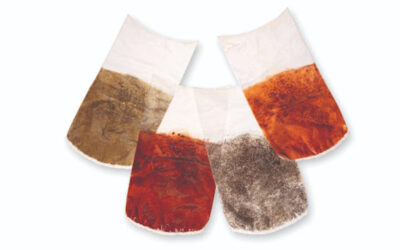
Flavorseal’s SureRelease High Performance Netting, for instance, pairs tight-weave construction with an integrated release treatment designed to reduce surface adhesion, combining shaping and pattern capabilities with improved removal characteristics.
This distinction matters. Tight-weave, extruded, and high-performance are not three mutually exclusive categories. High-performance netting builds on a base construction by adding treatments targeting specific processing requirements. The relevant criteria are not which label a product carries, but how its construction, treatment, and material properties perform under your conditions.
What Shoppers Actually Evaluate at the Retail Case
The connection between product appearance and retail performance is well documented. The specific contribution of netting to purchasing outcomes is harder to isolate.
Consumer research consistently identifies visual characteristics as primary drivers. A study in the Italian Journal of Animal Science found that consumers’ willingness to purchase beef was significantly affected by visible fat and overall appearance. Eye-tracking research reported in The National Provisioner showed that ideally colored meat images were preferred over pale or dark alternatives, and that longer visual examination correlated with higher appearance liking scores.
These findings were not conducted on netted products specifically, but they apply. For items where netting shapes the exterior, controls diameter uniformity, or transfers surface pattern and color, the net’s contribution becomes part of the visual equation shoppers evaluate.
Where this matters most is consistency across units. Consider a retail case filled with products of uniform shape, consistent surface coloring, and clean exterior presentation. That signals manufacturing control. Now consider the opposite: variability in shape, visible surface tears, uneven pattern transfer. The eating quality may be identical. The shopper’s perception is not.
Marketing teams evaluating netting options should treat this as a measurable variable: what does the product look like across a full production run, and does it meet the visual standards the retail customer expects?
Where Marketing and Operations Priorities Converge
Netting decisions are rarely made by a single department. Marketing focuses on differentiation, visual consistency, and retail presentation. Operations evaluates throughput, line reliability, clean release, labor, and yield. These perspectives are complementary rather than competing, but the real challenge is getting both teams to define “success” before selecting a netting, not after.
A net that releases cleanly reduces surface tears. That simultaneously protects yield (an Operations priority) and preserves appearance (a Marketing priority). A netting construction that produces consistent shapes across a run supports both efficient downstream slicing and uniform retail presentation.
Trade-offs tend to emerge in specifics:
- A tighter weave may produce a more defined surface pattern that Marketing values for differentiation, but it may also increase adhesion risk if the release treatment is not matched to the protein and cooking conditions.
- Improved release properties may increase throughput, but could alter the surface characteristics that define the product’s current retail identity.
These are not conflicts resolvable by choosing the “right” netting in isolation. They require collaborative evaluation and testing under actual production conditions. The processor who treats netting as a joint decision, rather than purely technical or purely aesthetic, is better positioned to find solutions that serve both functions.
Evaluating Netting in Your Own Processing Environment
Because netting performance depends on the interaction between construction, product, and process, selection decisions are best validated through testing rather than specification comparison alone. Spec sheets tell part of the story. Production runs tell the rest.
Practical evaluation typically considers:
- How the net fits and compresses the product during stuffing
- Whether it maintains shape through the full cook cycle
- How cleanly it releases
- What surface pattern and color it produces
- How the finished product holds up through slicing, packaging, and distribution
Production conditions matter more than many teams expect. A netting that performs well in a pilot test may behave differently at full line speed, with varying humidity, or across protein formulations that shift seasonally. Reliable evaluation accounts for these variables rather than assuming pilot results scale directly.
For processors reviewing their current netting or considering a change, a useful framework starts with clarifying the primary objective (improved appearance, better release, reduced waste, or a combination), defining acceptance criteria across both Marketing and Operations, and working with a supplier who provides application-specific guidance through testing.
Flavorseal’s SureRelease line spans tight-weave, high-performance, open-weave, elastic, and extruded options across a range of processing and presentation requirements, supported by a field technical team that works within each processor’s conditions rather than recommending one solution for every application.
Netting selection is a processing decision with direct retail consequences. The net that shapes, contains, and releases from a protein product influences what the shopper sees and evaluates. For teams balancing production efficiency and presentation standards, the most productive path is collaborative: define requirements across departments, then validate through testing in your own environment.
It is worth discussing how these considerations apply to your specific products and processes. For operations scaling toward higher volume, where netting performance directly affects throughput and retail presentation, Flavorseal’s technical team can help evaluate options under your actual processing conditions.